Home / Questions / Getting money out
Can you actually get your money back out? Yes — here is what it involves
The question people are too shy to ask, and the most sensible one on the list. Money that goes in and cannot come out is not an investment.
Which exit are you asking about?
This is the question people are too shy to ask out loud, and it is the most sensible one on the list. Money that goes in and cannot come out is not an investment, it is a donation. So: yes, it comes out. Here is what stands between you and your bank account.
The main route, step by step
Selling and withdrawing are two separate actions, and confusing them causes half the panic we hear about.
- Sell the asset for your local currency (or for a stablecoin, then for currency). This happens on the platform and is effectively instant. You now hold currency in your account — not in your bank.
- Withdraw that currency to your bank account. This is the regulated leg, and where the requirements live: verified identity, a bank account in your own name, and sometimes an additional confirmation step.
People often complete step one, see the currency balance, and think the money has arrived. It has not. It is still on the platform, and everything in the platform risk file still applies to it.
What it costs, and why we will not print a number
There are three charges and they behave differently:
- Trading fee when you sell — typically a small percentage, and the tier depends on your volume and any discount you have.
- Withdrawal fee for the bank transfer — sometimes a flat amount, sometimes free above a threshold, varying by currency and method.
- The spread, which is not labelled as a fee at all. On simple "convert" interfaces the spread is often wider than on the standard order book, and this quietly costs more than the visible fee.
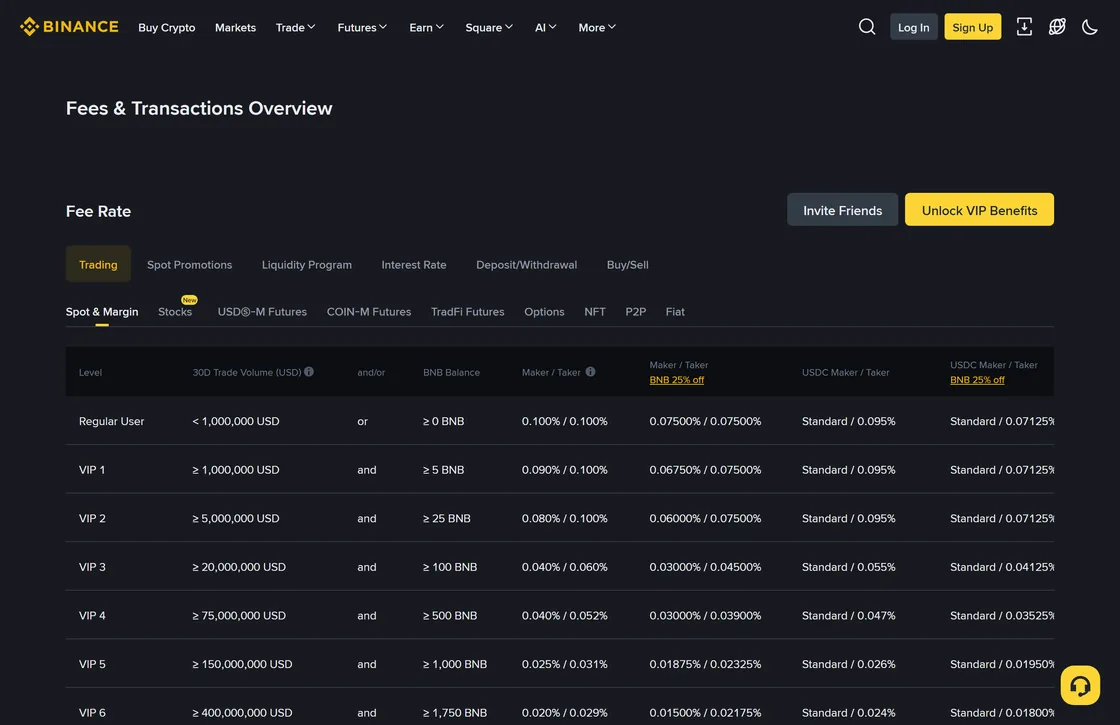
We are not printing specific figures because platform fee schedules change and a stale number on a page like this becomes a wrong number that someone budgets against. The current schedule is published by the platform — Binance's fee schedule, for instance — and it takes a minute to read. Do that before your first withdrawal rather than after.
Peer to peer, and the one risk that matters
In many countries the practical route is peer-to-peer: you sell to another user, who pays you by local bank transfer, with the platform holding the crypto in escrow until you confirm the money arrived.
This works and it is widely used. The risk is not usually the platform's escrow — it is the source of the money you receive. If the buyer pays with funds that turn out to be stolen, your bank account can be frozen while that is investigated, even though you did nothing wrong. This happens often enough in some jurisdictions that people plan around it.
What reduces it:
- Trade only inside the platform's escrow system, never by private arrangement.
- Prefer counterparties with substantial completed-trade history.
- Confirm the payer's name matches the counterparty's verified name, and refuse third-party payments.
- Keep the platform's trade record — it is your evidence if a bank asks.
- Do not release the crypto until the money is genuinely in your account. A payment notification is not the money.
The six places withdrawals actually get stuck
| Where it stops | Why | How to avoid it |
|---|---|---|
| Identity verification incomplete | A higher tier is required for withdrawal than for deposit | Complete full verification before depositing, not after |
| Name mismatch | Bank account name differs from the verified account name | Match exactly, including middle names and spelling |
| New method cooling-off | Anti-theft delay after adding a bank account or changing security settings | Add the withdrawal method early, before you need it |
| Source-of-funds review | A deposit pattern triggered a compliance query | Deposit only from your own accounts; answer queries promptly with documents |
| Bank rejects the incoming transfer | Some banks decline crypto-related transfers by policy | Find out your bank's stance before relying on it; some people keep a second account |
| Weekend and holiday timing | Bank rails do not run continuously | Do not start a withdrawal you need on Friday evening |
Five of those six are avoidable by doing things in a different order. That is the actual message of this page.
What "instant" and "pending" actually mean on the screen
Withdrawal screens use a small vocabulary that hides most of the delay, and knowing what each state means saves a lot of unnecessary alarm.
Submitted means the platform has accepted your request. Nothing has left. Automated checks are running, and if any of them flag, this is where it stops.
Processing means the platform has approved it and passed it to its banking partner. From here the platform genuinely cannot speed it up, which is why support answers at this stage are unsatisfying — the request is no longer in their system.
Completed means the platform has sent it. Not that it has arrived. There can be another business day between the platform's "completed" and the money appearing in your account, and this gap causes more panicked support tickets than anything else on the list.
For crypto withdrawals rather than currency, the equivalent is a transaction hash. Once you have one, the platform's part is finished and the transfer is on the network; you can look it up on a public block explorer and see the confirmations accumulate. No hash after a long wait means it has not been broadcast, and that is a platform-side question.
One consequence worth internalising: the moment a crypto withdrawal is broadcast, it is irreversible. There is no recall, no chargeback, and no support intervention. Address whitelists and small test sends exist precisely because this step has no undo.
Limits, tiers and the ceiling you did not know about
Most platforms apply daily and monthly withdrawal ceilings that scale with your verification level, and most people never notice because their amounts sit far below them.
The people who do notice tend to notice at the worst time — moving a larger sum than usual, often during a market event. Then they discover that the next verification tier requires a document they do not have to hand, and the queue for reviewing it is long because everyone else is doing the same thing.
Checking this costs two minutes. Find your account's current tier, find the ceiling attached to it, and ask whether it comfortably exceeds anything you might plausibly want to move in a day. If not, complete the next tier now, while nothing depends on it.
The same applies to any address whitelist. If your platform offers one, adding an address usually triggers a waiting period before it can be used. That is a feature and it is also a delay you should absorb on a quiet day rather than an urgent one.
What to do if a withdrawal is genuinely stuck
In order, and stopping at the first one that resolves it:
- Read the status and the notification email properly. A surprising share of stuck withdrawals are waiting on a confirmation step the person did not complete — an email link, an in-app approval, a document upload.
- Check the account's message centre inside the app. Compliance requests frequently arrive there rather than by email, and they sit unread.
- Confirm the receiving details. Name mismatch, an account that does not accept the currency, an intermediary bank rejecting the transfer. Your bank can tell you whether something arrived and was returned.
- Open a ticket through the app, not through a search. Include dates, amounts, and reference numbers. Then wait — and know that nobody who contacts you privately offering to escalate it is support.
- Escalate formally if it stays unresolved. If the platform is authorised in your country, its regulator usually has a complaints route, and the platform's own complaints procedure is a documented step you can invoke. This works considerably better with a licensed firm than an unlicensed one, which is a point in favour of checking that before depositing rather than after.
What not to do at any stage: pay anything. No legitimate platform requires a payment to release your own balance — no tax, no unfreezing fee, no verification deposit. If that is what you are being told, the situation is a different one entirely, and the after-the-fact checklist is the right page.
The tax part people forget until later
In many countries, selling is a taxable event whether or not the money reaches your bank, and swapping one asset for another can be too. If you sell, you may have created a tax position even if you leave the currency sitting on the platform.
Export your transaction history when you make the trade rather than a year later, and keep it somewhere that is not the platform. Platforms have withdrawn from markets, changed export tools, and limited history depth. Your own copy costs nothing. The legal ground file covers where to find your own tax authority's guidance.
Test it now, with a small amount
Everything above becomes theoretical if you never try it. The single most useful thing a new account holder can do is push a small amount all the way back to their bank account, on a quiet day, when nothing depends on it.
You find out: whether your verification tier is sufficient, what the fee really is, how long your bank actually takes, whether your bank accepts the transfer at all, and whether the name on the account matches. Every one of those is a thing people discover during a market panic instead, in a support queue, with everyone else who is also discovering it.
It costs one small fee. It is the cheapest insurance on this site.
The withdrawal questions we get most
- How long does it take to get money into my bank account?
The crypto-to-currency sale is near-instant. The bank leg is the slow part and depends on your country's payment system: same-day in places with instant transfer rails, one to three business days in many others, longer across borders or over a weekend. First withdrawals often take longer than later ones because of additional checks. Treat any specific number you read as a guide and check the platform's own page for current processing times.
- Why is there a hold on my first withdrawal?
Because it is your first. Platforms commonly apply a waiting period after a new withdrawal method, a password change, or a new device — typically measured in hours to a day. It is an anti-theft measure, and it is one reason to set up and test withdrawals when you are not in a hurry.
- Can I withdraw to someone else's bank account?
Generally not, and attempting it is a reliable way to get an account reviewed. Regulated platforms require the receiving account to be in the same name as the verified account holder. Third-party transfers are a money-laundering flag everywhere, and the review that follows is slow.
- What if the platform stops serving my country?
This does happen, and platforms normally give a withdrawal window with a deadline. The important part is noticing — announcements go to the registered email address and in-app notices, which is a reason to use an email you actually read. Missing the window turns a simple withdrawal into a support case.
Last checked August 25, 2026. Spotted something wrong? Write to the desk — anything we get wrong ends up on the corrections page.